
Sometimes the best gift I have to give you is my imperfections. Years ago, I was taught that perfection obstructs happiness. And in practice, I’ve come to believe that what I most genuinely have to offer is not a polished version of myself, but my humanness, my edges, my learning curve.
When Perfection Steals the Joy of the Process
The other day I was making a doll for the little girl next door, trying to get it “just right.” You can imagine it: the tiny details, the tug to make it look good, the voice that says, I can’t do this. Maybe I should just buy her one. At some point, I had to surrender and simply make it work, with a few flaws. And in that letting go, I had a moment of recognition.
How often do we get caught up in the end result and miss the joy of the process?
How often do we believe love is earned or that we’ll be accepted if we get it right?
I had an aha moment: Maybe there’s a bigger gift here than a doll. Maybe it’s the practice of loving what’s imperfect, because that’s all of us. So, I’ll ask you what I asked myself: Where are you right now with accepting your imperfections? The quandary isn’t only how we accept ourselves with our flaws; it’s also how we accept others.
Perfectionism as Protection
Perfectionism isn’t always vanity. It can be protection. When the nervous system learns that “getting it right” reduces risk, the body adapts. It tightens. It braces. It works overtime to prevent criticism, disapproval, or that awful feeling of being left out. For many of us, this isn’t a mindset we chose. It’s a pattern we learned.
In my own Brainspotting journey, I noticed how much effort I was putting into being “okay” by my own standards. I didn’t always see it as perfectionism. I saw it as being responsible, caring, and thorough. Yet those self-expectations quietly leaked into relationships, sometimes without my awareness. I remember being confronted about being a perfectionist and thinking, What? Me? I’m so imperfect. And still, even while I “knew” I was flawed, I wasn’t always being kind to myself, or others, about that truth.
The Illusion of Certainty
It also protects us from uncertainty. When things are shaky, when we don’t know how something will land with another, how they will respond, or whether what we are doing will “gain us points,” perfection can feel oddly comforting. It becomes a way of trying to manufacture certainty and avoid some possible disappointment or discomfort.
What I’ve discovered through my years of being with Brainspotting, both as a professional and client, is the power of uncertainty. Uncertainty is a part of life, and learning to be with it can be a relief to the inner perfectionist. In the Brainspotting world, we often speak about the Uncertainty Principle: when we sit with no expectations and trust the client’s innate wisdom, we’re entering uncertainty in a way that can open the door to deep healing. I’ve felt that over and over, personally and professionally.
Listening to Perfectionism Through the Body
Brainspotting invited me into a different relationship with it. Not to battle the perfectionism, but to listen to it. To notice where it lived in my body. To pay attention to my eyes, my breath, my posture, and that inner pressure that says, Try harder. Do better. Don’t slip.
As I stayed with those sensations in session and let the brain and body do what they know how to do, more began to show itself. The young one who forgot her lines in the school play. The one who felt left out and “not enough.” The one who was told she was fat and ugly. Many voices and images moved through me. Over time, they softened. The grip eased. The urgency faded. Something more organic returned and began to replace the old programs. Life got easier. And the kindness I’d offered others started to become more available to me.
In The Spirituality of Imperfection, Katherine Ketcham writes, “At the most fundamental level of our very human-ness, it is our weakness that makes us alike; it is our strengths that make us different.”
Softening Into Self-Acceptance
I would truly love to hear: What has helped you on your journey over the years? What supports you in softening toward yourself?
I’ve discovered that the more I drop into healing, the more self-acceptance seems to arise, almost naturally. I became gentler with my imperfections. And when something in me still feels bothered, I try to get curious. What’s underneath this self-demand? What pain might it be covering? From there, I choose a supportive approach. Maybe I Self-Spot, or I bring it to my Brainspotting partner or therapist. Whatever route you take, there is great value in the healing journey of returning to what’s most authentic in you.
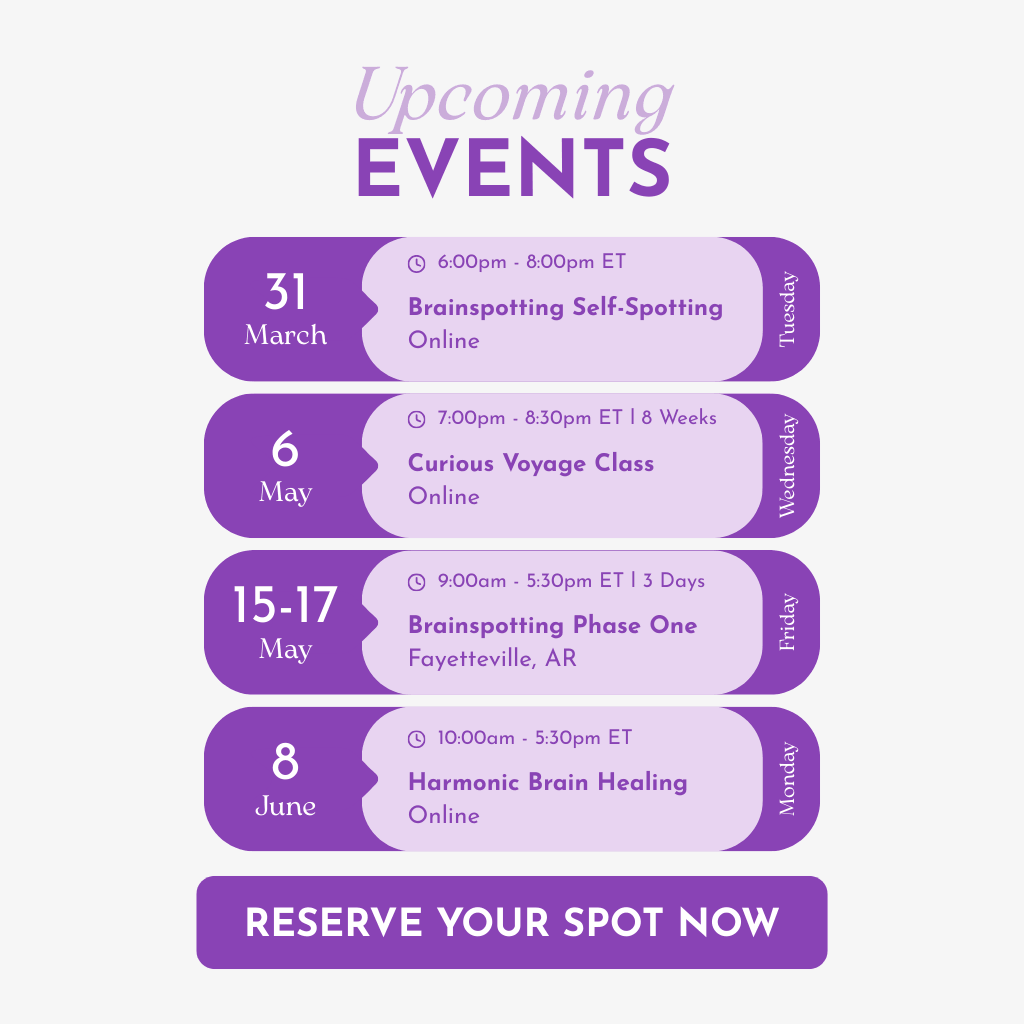
If you’re curious about Brainspotting, you’re warmly invited to join us March 6–8 in Florida for Brainspotting Phase One, or March 31 for Self-Spotting.