
His Wall is so High
His wall is so high
I can’t climb over,
but I sure do try.
I try with my love.
I try with my pain.
I try with my anger.
But sure do I try.
His wall is so high.
I try to climb over.
I try with my beauty.
I try with my pain.
I try with my pleasing.
But boy do I try.
His wall is so high.
I try to climb over.
I try with my seduction.
I try with my passion.
Oh boy do I try.
I have chosen not to try.
I rest.
I feel.
I heal the pain.
I feel free.
I wrote this poem years ago, long before I understood Parts Work and before I joined Al-Anon. Looking at it now, I can see there was a part of me that believed that if I just kept trying, I would finally be loved, noticed, and supported.
I learned through my inner work, using tools from Al-Anon, Brainspotting, spiritual teachers, and therapists, how important it is to feel the pain, listen for the wisdom underneath it, and sometimes let go.
Letting go can be frightening.
We may fear that if we stop trying, we will lose the very thing we are after. Yet, often it is because of the trying so hard we actually lose it (them).
But what if, in all that trying, it is ourselves we appear to have lost?
We don’t actually lose ourselves. It’s more like we go into forgetting who we truly are. We act from the parts of us that live more in fear than our authentic self. It is in a sense a disconnection from the wise, knowing part of ourselves. The part that already knows something about who we are and what is true for us.
Over the years, I have gone from feeling spaced out, uncertain, and lost to believing that if I could just get enough support from others I would be okay. However, I discovered the parts of me that did not feel supported were the ones that needed the attention of my wiser part. Yet, they were not connected to that internal space. It was like all the lost, confused, scared parts were in a movie and the wiser part was way in the back in the theater waiting to be asked to join the show. Once it did, in some version, healing and integration began.
The part of me that kept trying was longing for love. It was focused outward, on what other people wanted, how they were feeling, and what I might need to do to keep the connection. In some ways, it was also trying to protect me from other people’s anger: If I please them, maybe I will be okay.
Does any of this sound familiar?
Maybe your trying looks different. You may try to keep everyone happy. Try to fix what is wrong. Try to prove yourself. Try to control what you can’t. Try harder when someone pulls away. Try to anticipate what other people need before they even ask. All these methods are different versions of disconnection.
They developed as a form of self-preservation. You learned certain ways of thinking, behaving, and moving through the world because, at some point, those ways helped.
As I did my personal work, I began to understand how important it was not simply to stop the trying, but to sit with the part that was doing it and get to know it. What was it afraid would happen if it stopped? What did it believe it had to do for me? What did it need now that it could not receive then?
Parts Work can guide us back home to ourselves, both experientially and conceptually. It can help us discover what has been hidden, disguised, or difficult to understand and begin relating differently to the parts of us that have worked so hard to protect us.
Maybe the question isn’t, “How do I try harder?” but, “What part of me believes I still have to?”
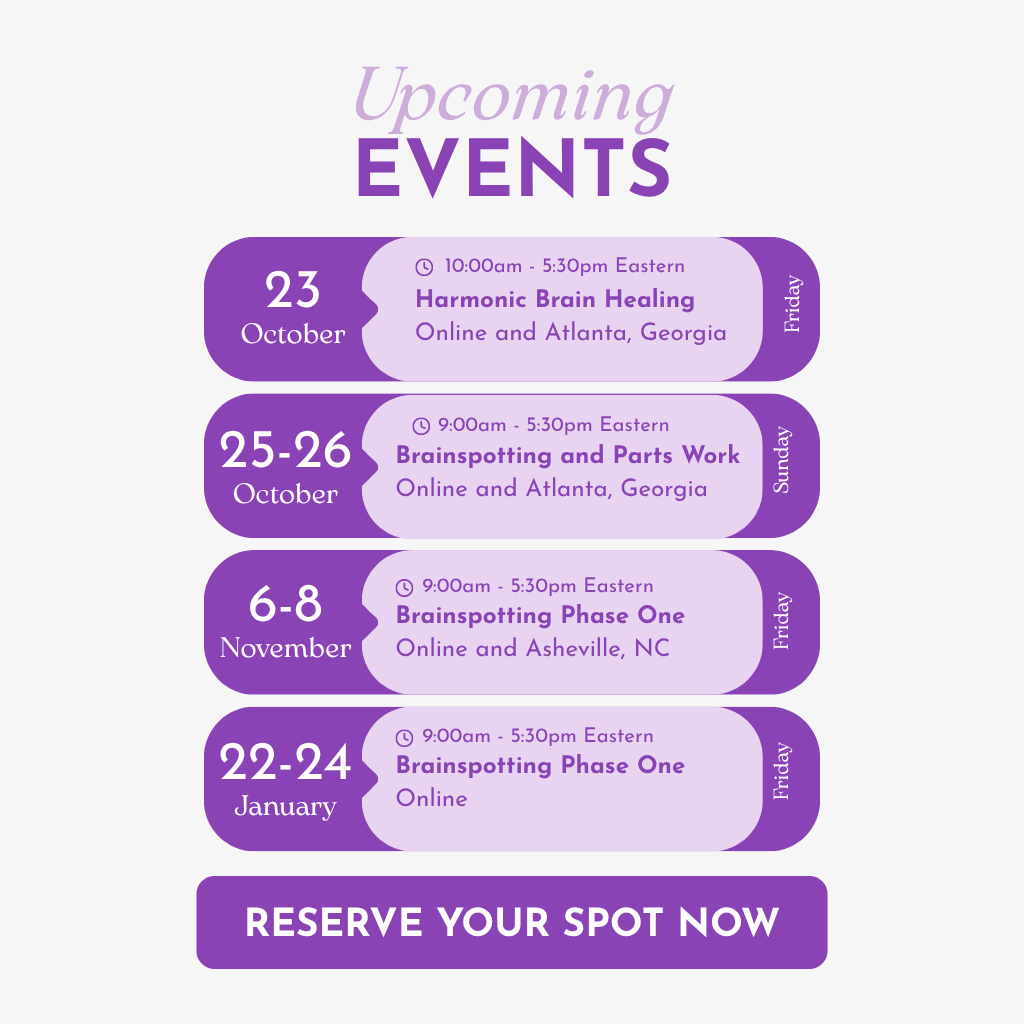
If you are a Brainspotting therapist and want to get curious about working with parts personally and professionally, click below on the Brainspotting and Parts Training or Group. For others who want a tool for working with parts, here is a worksheet and a YouTube video.
Brainspotting & Parts Consultation Group | Cynthasis
Brainspotting and Parts Work October 25-26, 2026 – Cynthasis